

Latest news
A research team led by Professor Yang Jun from the College of Materials Science and Technology has made significant progress in biomass-based gel interface materials. Their findings, published in ACS Nano (IF=16.1), introduce an integrated biointerface platform capable of both real-time electrophysiological monitoring and on-demand wound therapy.
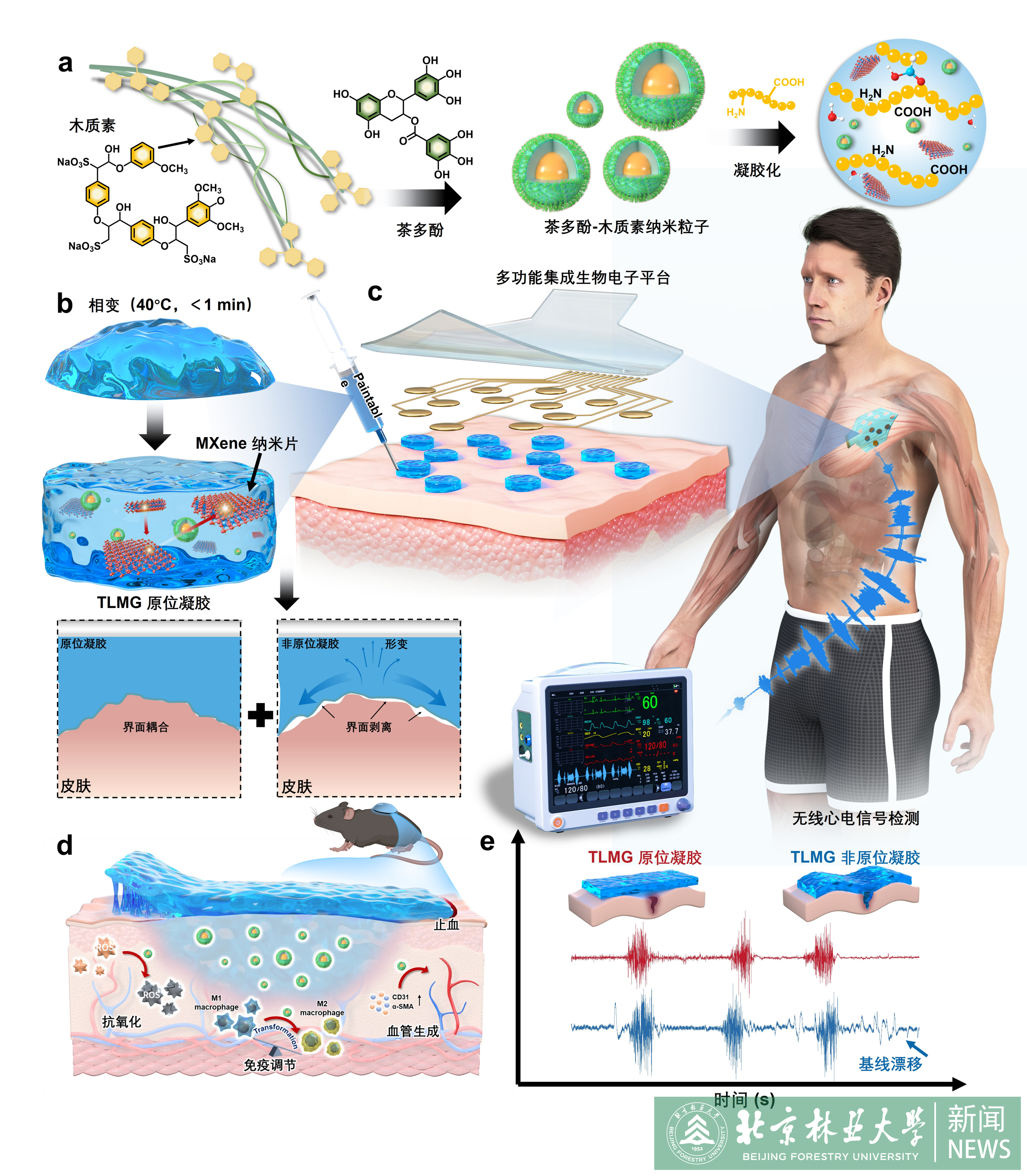
Flexible bioelectronic interfaces hold great promise for advancing modern healthcare and human–machine interactions. However, current bioelectronic interface technologies remain constrained by the intricate surface conditions of injured tissues. Even with intimate tissue-electrode adhesion, achieving simultaneous sensing and therapeutic intervention poses a formidable challenge. Here, we employed the principle of liquid-to-solid conversion to develop a seamless in situ forming biointerface platform, TLMG hydrogel, with robust and stable adhesion to irregular skin wounds, enhanced mechanical properties, real-time high-fidelity signal monitoring, and on-demand therapeutic effect for wound healing. By incorporating tea polyphenols/lignin microspheres, the TLMG hydrogel effectively achieved the integration of bioelectronic and bioactive interfaces. The multiple features of this in situ biointerface encompassed robust in situ adhesion (200 kPa), high ionic conductivity (0.27 mS cm–1), and exceptional mechanical stability. Furthermore, the findings from several complex animal models and human tests proved the intelligent wound management, real-time dynamic signal monitoring, and wound healing boosting via immunomodulatory mechanisms. These results convincingly indicate that the TLMG biointerfacing platform provides a promising solution for integrated bioelectronic medicine for wearable healthcare systems.
The paper's co-first author is Dr. Hao Sanwei, a recent doctoral graduate from the College of Materials Science and Technology, with Professor Yang Jun as the corresponding author. This work is supported by the Beijing Natural Science Foundation (grant number L252200, W.Y.).
Paper link: https://pubs.acs.org/doi/10.1021/acsnano.5c17466
Written by Yang Jun
Translated and edited by Song He
Reviewed by Yu Yangyang