

Latest news
A research team from the College of Grassland Science and Technology at Beijing Forestry University, in collaboration with the Xinjiang Institute of Ecology and Geography of the Chinese Academy of Sciences, the Ili Grassland Work Station, and Shandong Aviation University, has made new progress in evaluating the effectiveness and resource inputs of no-till reseeding for grassland restoration. The findings were published online in Journal of Environmental Management (IF=9.2, JCR Q1 in Environmental Sciences).
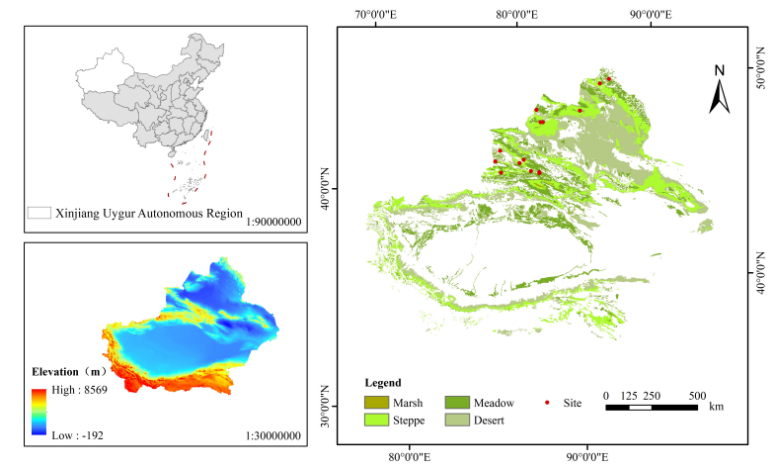
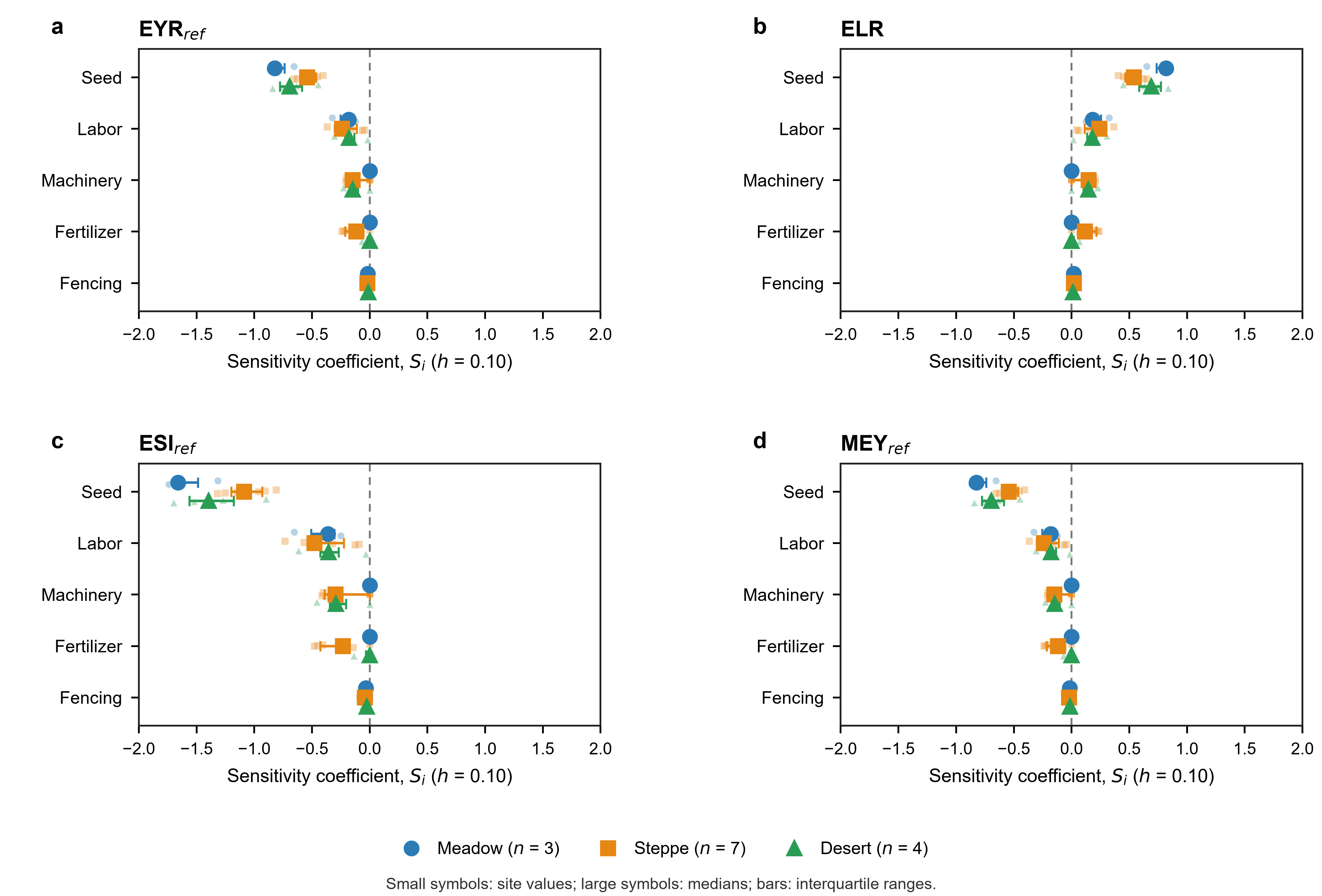
Grassland restoration performance depends not only on engineering interventions but also on local reference conditions and resource-use patterns. The research team assessed 14 no-tillage reseeding projects in northern Xinjiang (3 meadow, 7 steppe, 4 desert) by integrating four renewable environmental inputs, five budget categories, and concurrent reference- and engineering-area dry-matter and vegetation surveys in a site-level reference emergy framework. Meadow sites had the highest median reference-area output (8.391 × 10¹⁰ sej m−2), reference emergy yield ratio (EYRref = 3.796), reference emergy sustainability index (ESIref = 2.274), and marginal reference return (MEYref = 1.566), and the lowest environmental loading ratio (ELR = 1.359). Steppe sites had the largest median relative output contrast (ΔY = 245.7%). None of the nine grassland-type comparisons was significant after Holm adjustment, so these patterns describe the sampled sites. Engineering-minus-reference medians were +38.6 percentage points for total cover, +0.93 operational taxa per quadrat for richness, and +0.182 for Shannon diversity; all were significant after Holm adjustment, but none of six prespecified associations with ΔY or ESIref was significant. MEYref was positively associated with ESIref (ρ = 0.855, Holm-adjusted P = 0.00045), whereas ΔY–ESIref was positive but uncertain (ρ = 0.376, P = 0.187); formula-preserving diagnostics showed compatibility with shared calculation components. Overall, meadow sites combined higher output and marginal return with lower purchased-input loading, steppe sites showed the largest output contrast without a corresponding rise in ESIref, and desert sites had lower median performance. Under fixed-output assumptions, seed had the greatest influence on ESIref followed by labor. These findings support joint consideration of local reference conditions, vegetation responses, and input efficiency in differentiated restoration review.
Beijing Forestry University is the signature unit of the first author. Wang Ping, a doctoral student at the College of Grassland Science and Technology, is the first author, with Associate Professor Zhang Jing and Professor Ji Baoming as co-corresponding authors.This work was supported by the Third Xinjiang Scientific Expedition Program [grant number[2022xjkk0403].
Paper link: https://doi.org/10.1016/j.jenvman.2026.130986
Written by Wang Ping, Zhang Jing
Translated by Song He
Edited by Chen Ruirui
Reviewed by Yu Yangyang