



Latest news
A research team led by Professor Wen Jian from the College of Engineering has made significant progress in the non‑destructive detection of tree root systems. Their findings, published in IEEE Transactions on Geoscience and Remote Sensing (IF=8.6), introduce an intelligent inversion method that integrates ground‑penetrating radar (GPR) with physics‑constrained deep learning.
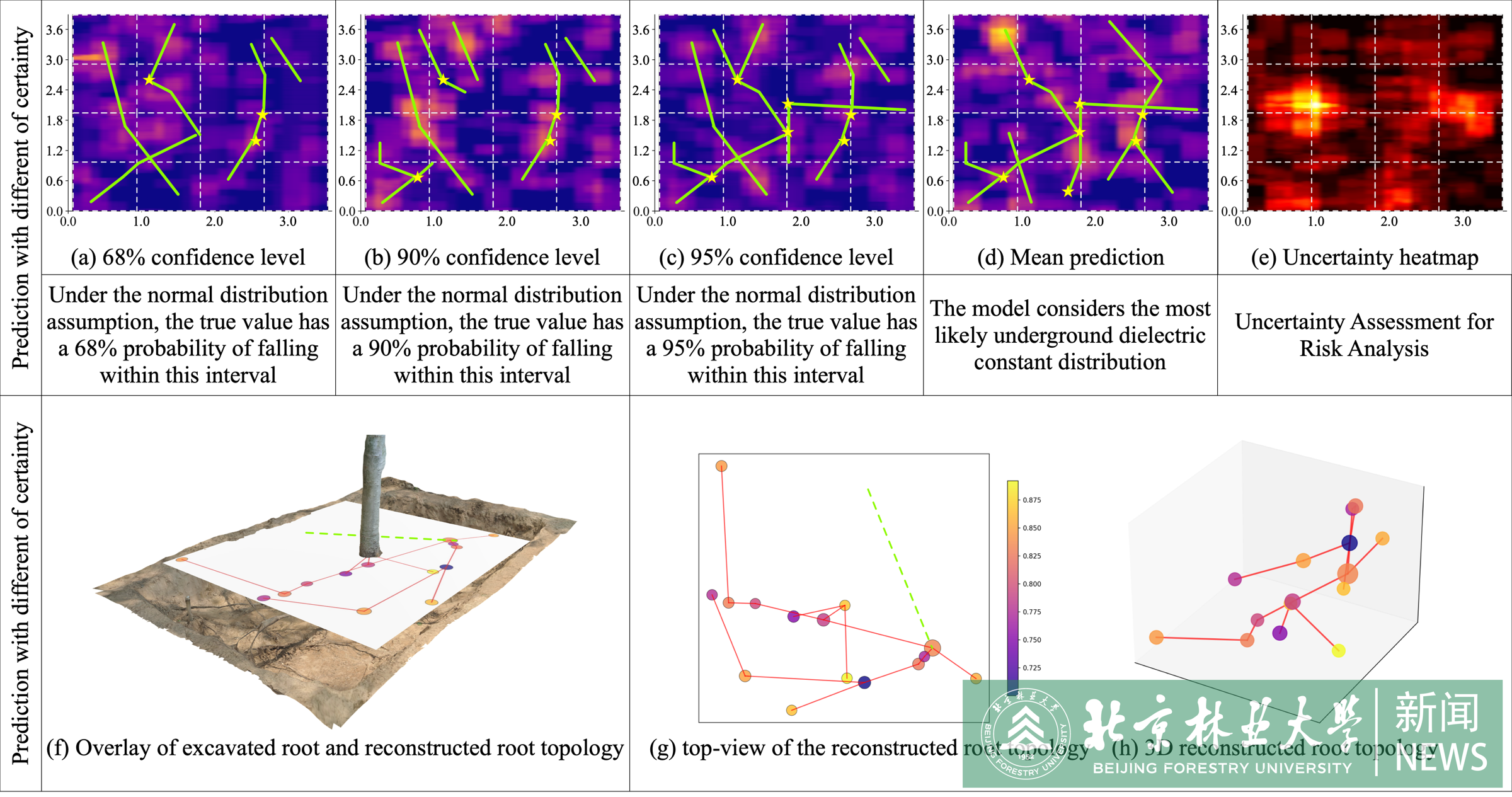
Ground-penetrating radar (GPR) enables noninvasive subsurface root detection, yet existing approaches suffer from limited uncertainty quantification and poor cross-domain generalization capabilities. This article presents a physics-informed variational generative framework that integrates electromagnetic propagation principles with probabilistic deep learning to achieve reliable subsurface root characterization with principled uncertainty assessment. The framework embeds frequency wavenumber migration constraints and signal feature attribute transformation directly within a variational autoencoder (VAE) architecture, enabling simultaneous 3-D root reconstruction and uncertainty-aware prediction while achieving data efficiency through physics-guided regularization. A multilevel confidence assessment strategy provides flexible decision-making tools spanning from conservative high certainty detection to comprehensive coverage analysis. Comprehensive field validation against excavated ground truth demonstrates high-fidelity preservation of complex root network topologies and enables systematic quantitative phenotypic parameter analysis encompassing morphological, architectural, functional, and biomass-related traits. Notably, the framework exhibits robust cross-domain transferability through physics-informed constraints alone, eliminating dependence on extensive labeled training data across diverse environmental conditions. This work establishes that principled integration of physical constraints with variational learning paradigms enables reliable, uncertainty-aware subsurface characterization methodologies with significant implications for forestry, ecological, and precision agriculture applications.
The paper's first author is doctoral student Zhao Xuan, with Professor Wen Jian as corresponding author and Beijing Forestry University as the signature unit of the first author. The research was supported by the National Natural Science Foundation of China (32071679) and the Beijing Natural Science Foundation(6202023).
Paper link: https://ieeexplore.ieee.org/document/11421474/
Written by Zhao Xuan, Wen Jian
Translated by Song He
Reviewed by Yu Yangyang


